This 3d rendering was created using blueprints given to Pioneertown Sun by longtime Pioneertown resident Gay Smith.
Use left mouse button to rotate. Right mouse and W, S, D, A, keys to move
The Golden Stallion stood at the lower end of Mane Street during Pioneertown’s early years, when the town was still trying to fulfill Dick Curtis’ original dream of a permanent Western movie community. Like many of Pioneertown’s buildings, the Golden Stallion was not a flimsy false front. It was a real structure, built with old railroad ties cemented together, giving it the rugged appearance expected of a frontier street while housing a modern dining operation inside. A 1950 Saturday Evening Post article described the restaurant as representing a $75,000 investment—a major commitment in a young desert town still struggling to prove itself.
The dining room became part of the attraction. A 1955 Desert Sun article described the Golden Stallion as famous for Chinese cuisine and remembered its “Chinese Cowboys” novelty, life-sized murals of Trigger in gold leaf on light blue walls, and a large fireplace that welcomed guests on cool desert evenings. It was not merely a place to eat; it was part restaurant, part roadside legend, part Hollywood fantasy, and part community anchor.
The restaurant was operated by Frank Gee and Henry Jew, two San Francisco men who were reportedly Western movie fans and had heard about Pioneertown through radio promotion. That origin story fits perfectly with Pioneertown’s larger mythology: people drawn by Hollywood, the desert, and the possibility that an invented Old West town might become a real destination. By 1955, the Golden Stallion had become one of the places visitors remembered most after a trip to Pioneertown.
What made the Golden Stallion so unusual was the contrast between setting and cuisine. Visitors came to Pioneertown expecting cowboys, horses, saloons, hitching posts, and dusty streets. At the Golden Stallion, they found Chinese food served inside a Western movie town. Newspaper accounts celebrated that unexpected mix. A 1953 Desert Sentinel advertisement declared the Golden Stallion one of Southern California’s top Chinese restaurants and claimed people drove hundreds of miles to eat there. The same ad said the restaurant had helped make Pioneertown famous for having some of the finest Chinese food in the state.
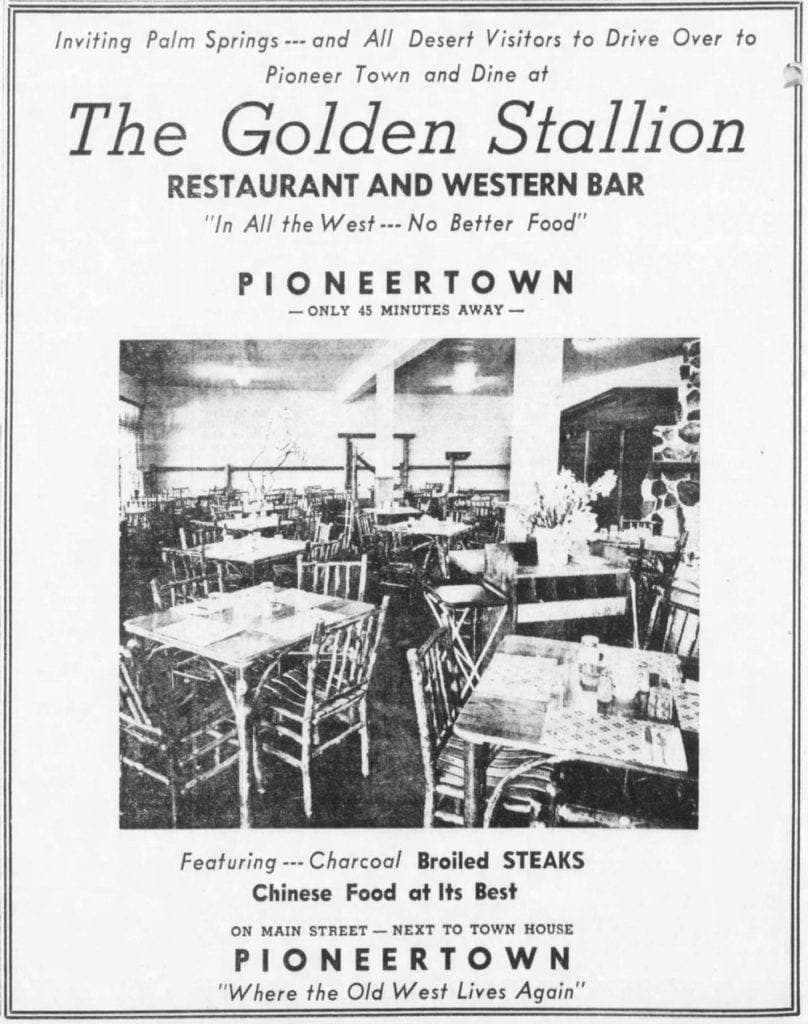
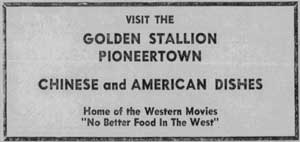


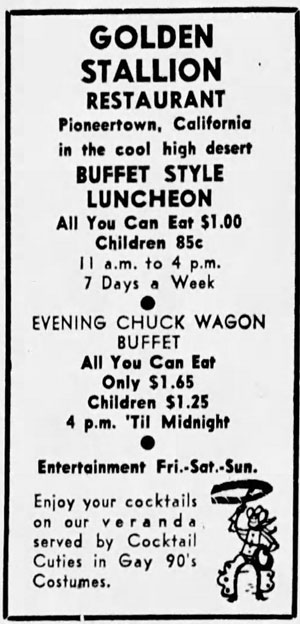
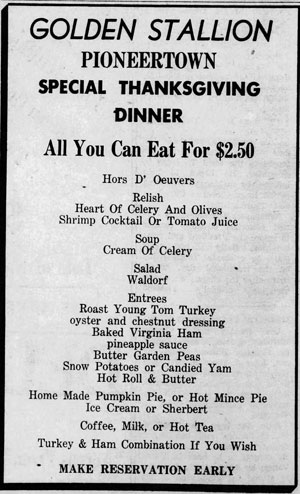

The Golden Stallion also reflected Pioneertown’s original business model. The town was designed so that the buildings on Mane Street could function as real businesses while still appearing camera-ready for Western films. The official Pioneertown history explains that Pioneertown’s early businesses included the Golden Stallion Restaurant, Townhouse Motel, Nell’s Ice Cream Palace, the Red Dog Saloon, White’s Grocery, the Golden Nugget Coffee Shop, Maggie’s Feed Barn, Klip ’N’ Kurl Beauty Shop, and Trigger Bill’s Shooting Gallery. In the late 1940s and 1950s, Pioneertown was meant to thrive as both a community and a film set.
The Golden Stallion sat close to the Pioneertown Townhouse Motel, another railroad-tie building designed to appear rustic outside while providing modern accommodations inside. This relationship between restaurant, motel, post office, saloon, bowling alley, corral, and movie street was central to the founders’ concept. A film crew could arrive, shoot Western scenes, eat in town, sleep nearby, use local horses, and work in a place where the entire street maintained its Old West appearance.
By the early 1950s, Pioneertown’s future seemed uncertain, but the Golden Stallion remained a bright spot. The larger corporate dream behind Pioneertown had begun to weaken as filming failed to arrive at the scale originally hoped for and the town’s founding corporation ran into financial trouble. Yet the Golden Stallion continued to attract attention as one of the businesses that gave Pioneertown credibility beyond its novelty. It was a destination within a destination.
The restaurant’s reputation survived even after Pioneertown’s first boom faded. In 1957, after Pioneertown had gone bust and the population had dropped sharply, newspaper coverage still noted that the Golden Stallion remained open. It served both Chinese and American dishes, advertised itself with the bold claim “No finer food in the West,” and offered everything from simple sandwiches to almond duck. Frank Gee was identified as proprietor, and the restaurant was open seasonally from March through November.
That detail is important because it shows the Golden Stallion’s role in the survival period of Pioneertown. After the original movie-town dream faltered, a small group of residents and business owners kept Mane Street alive. Honey Fellers, writing in 1957, referred warmly to Frank Gee and the Golden Stallion, describing his American-Chinese dishes as famous and placing him among the small band of people who had stayed, struggled, and continued to believe in the town.
The Golden Stallion was later folded into another grand plan for Pioneertown: the California Golden Empire development of the 1960s. That plan imagined Pioneertown as the historic and commercial heart of a much larger resort and residential development. Newspaper coverage from 1966 described Mane Street as including the Golden Stallion Restaurant and bar, post office, printery, general store, antique shop, jail, trading post, bowling alley, and other Old West-style buildings. The same article mentioned planned additions to the Golden Stallion Lodge, whose units had reportedly served as dressing rooms for movie stars during filming.
By that time, the Golden Stallion was connected to Jack Bailey, the actor and television personality known for “Queen for a Day.” Bailey had purchased the restaurant only months before disaster struck. His ownership tied the old restaurant to yet another attempt to revive Pioneertown as a visitor destination, but that effort was cut short in dramatic fashion.
In April 1966, Pioneertown suffered a devastating series of fires. The Red Barn was damaged first. Then the Red Dog Saloon burned. Two days later, the Golden Stallion was destroyed. A San Bernardino County Sun reported that the Golden Stallion burned to the ground, causing more than $50,000 in damage. The fire was reported early in the morning, and firefighters battled it for hours as the railroad-tie construction continued to burn.
The article described the Golden Stallion as a 50-by-100-foot structure containing a dance floor, dining room, bar, offices, and living quarters. A man sleeping in the living quarters escaped with slight burns. Firefighters from multiple departments responded, but the building could not be saved. In one weekend, Pioneertown lost two of its most important gathering places: the Red Dog Saloon and the Golden Stallion.
The destruction of the Golden Stallion marked more than the loss of a restaurant. It was the end of one of Pioneertown’s most vivid early chapters. The building represented the ambition of the original town: real businesses hidden behind Old West facades, serving tourists and movie people in a setting unlike anywhere else. It also represented the grit of the residents who kept Pioneertown alive after the first dream collapsed.
Today, the Golden Stallion survives mostly through photographs, newspaper clippings, advertisements, and memories. Those records show a business that was both improbable and perfectly suited to Pioneertown: a celebrated Chinese restaurant in a Western movie town, built of railroad ties, decorated with Hollywood cowboy imagery, and remembered long after the flames took it down. It was one of the places where Pioneertown’s fantasy became real—not because it looked like the Old West, but because people actually lived, worked, ate, gathered, and dreamed there.